

Your Business Is Sitting on Headlines. You’re Just Not Looking at Them.
How to Use Your Own Business Data to Generate PR and National Press Coverage
Most brands think they need a big campaign idea to generate national press coverage.
They don’t.
Some of the strongest PR stories don’t come from brainstorms. They come from something far simpler: paying attention.
Inside almost every business is a live feed of behavioural insight. What customers are buying. What they’re abandoning. What they’re returning. When they surge. When they disappear.
And when you look at that data through a storytelling lens, it often reveals something much bigger than your brand.
It reveals how people are living right now.
The Untapped PR Goldmine: Your Own Data
Brands frequently commission research to “create” news.
But many are already sitting on something more powerful - real-world behavioural data.
Your order history.
Your bookings.
Your enquiries.
Your search trends.
Your cancellations.
Your complaints.
This isn’t hypothetical. It’s not opinion-based. It’s action.
And action tells the truth.
For example:
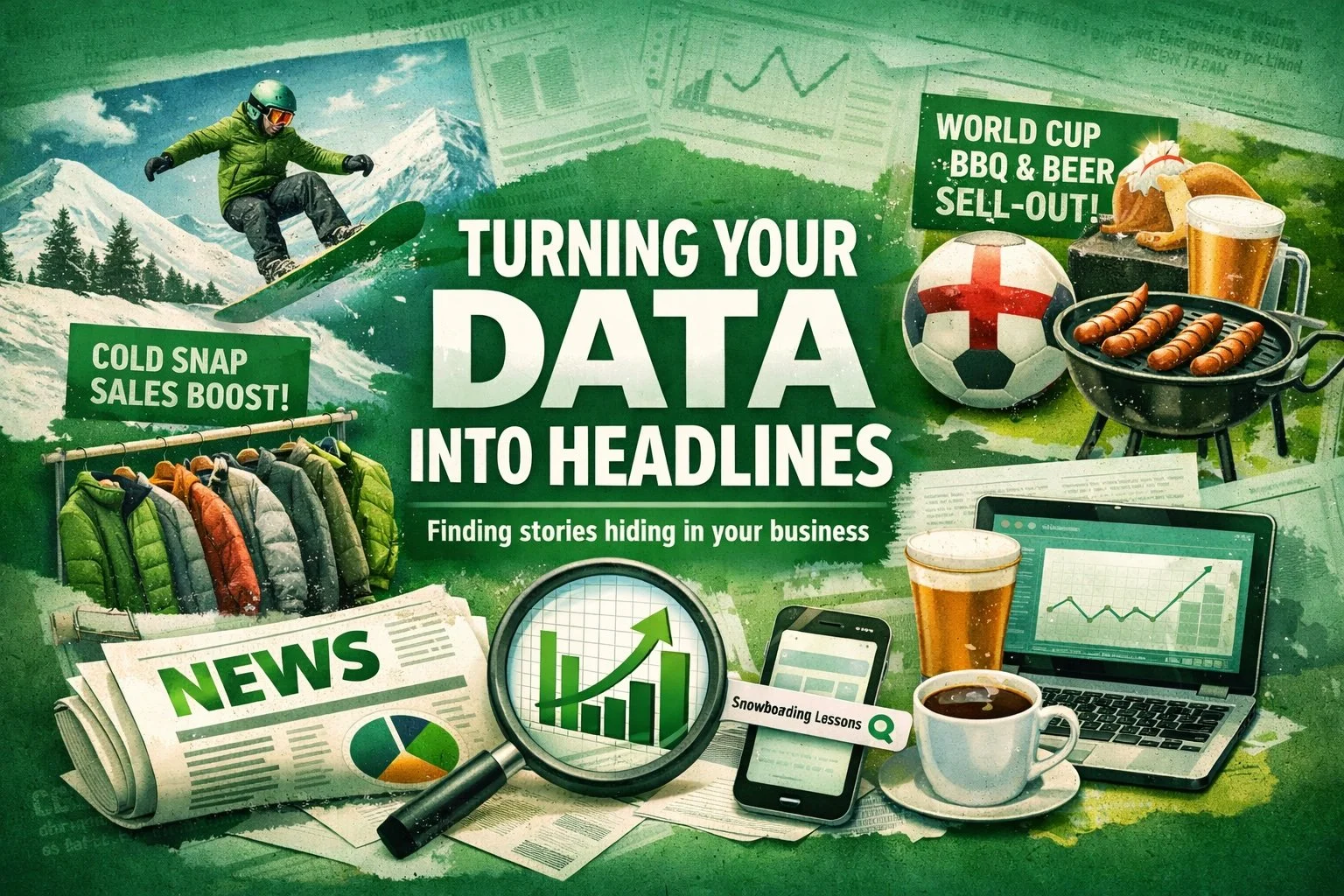
A sudden cold snap hits and outdoor clothing sales quietly spike.
England goes on a strong tournament run and BBQ food, beer and garden equipment start selling out.
A British athlete performs well at the Winter Olympics and bookings for snow sports lessons increase alongside search demand.
None of these start life as PR campaigns.
They start as patterns.
But those patterns reflect national mood, optimism, seasonality, celebration, caution, indulgence — and that’s what makes them newsworthy.
When Data Becomes a Headline
Data becomes media-worthy when it stops being about your business and starts being about people.
Journalists are looking for signals. They care about:
Change - What’s up? What’s down? What’s shifting?
Contrast - What’s happening versus what we expected to happen?
Timing - Why does this matter now?
Scale - Does this reflect something bigger than one company?
When your numbers highlight a behavioural shift that mirrors broader society, you’re no longer pitching a product.
You’re offering insight.
That’s the difference between coverage and silence.
Why This Works in 2026’s Media Landscape
Newsrooms are leaner than ever. Journalists need:
Credible data
Timely angles
Evidence-backed commentary
Stories that connect to real life
Brands that can provide real behavioural insight - responsibly and accurately - become valuable sources.
And that builds long-term media relationships, not just one-off coverage.
A Simple Framework: Turning Internal Data Into PR
Before you commission research or brief your creative team, try this first.
Ask:
What surprised us this month?
What didn’t behave how we expected?
What dropped off faster than planned?
What quietly overperformed?
What does this say about people right now?
If you can answer those questions, there’s likely a story already forming.
The job of good PR isn’t always to invent something new.
Sometimes it’s to spot what’s already happening and frame it correctly.
From Intelligence to Impact
At Down at the Social, we believe the strongest campaigns start with intelligence. Ideas come second. Influence follows.
When you combine behavioural data with strong narrative framing, you don’t just get attention, you get relevance.
And relevance is what drives reach, credibility and ultimately commercial impact.
Sitting on Something Interesting?
If you’re noticing unusual patterns in your sales, bookings, customer behaviour or search demand and you’re unsure whether it’s a story - it might be.
We’re always happy to sense-check angles and explore whether your internal data could become something bigger.
Because sometimes the headline isn’t something you need to create.
It’s something you just need to recognise.
Get in touch now… here.